

Two 1,200 kWth natural gas boilers serving a 39,000 m² commercial office tower in Sydney's CBD were removed and replaced with four 265 kWth Geoclima R290 heat pumps and thermal storage. The building now runs with no gas, its 5.5 star NABERS Energy rating is designed to hold under the 2030 methodology update, and 100% of Scope 1 emissions are gone.
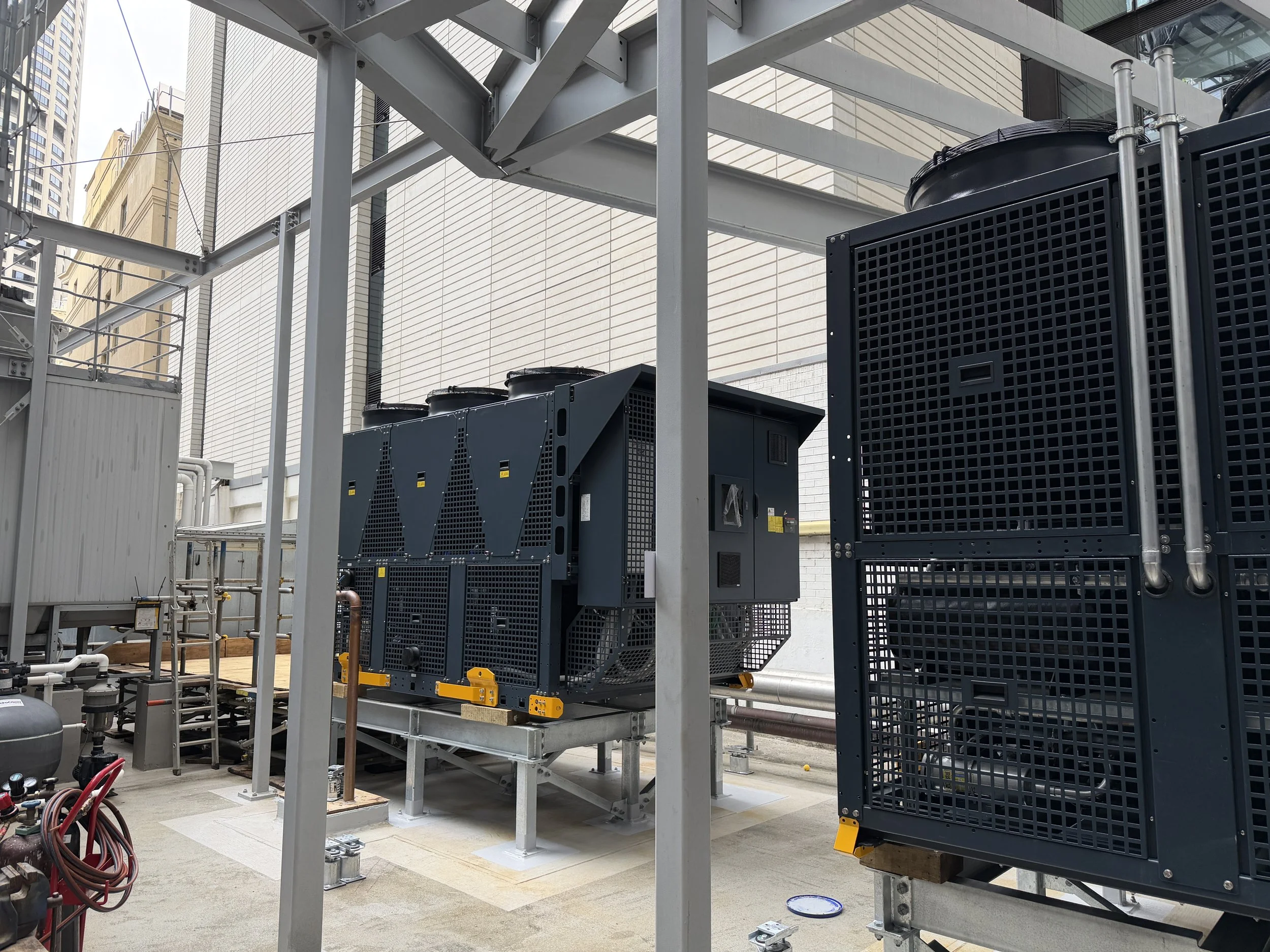
Four Geoclima R290 heat pumps on the rooftop plant platform at 200 George Street, Sydney
at a glance.
Client: Mirvac
Building: 39,000 m² commercial office tower, Sydney CBD
Plant removed: 2 × 1,200 kWth natural gas boilers (2,400 kWth), fully decommissioned
Plant installed: 4 × 265 kWth Geoclima R290 air-source heat pumps (1,060 kWth) plus thermal storage
Installed heating capacity: 1,060 kWth, which our load analysis confirmed was all the building needed.
Heating hot water: reduced from 80 °C to 70 °C, confirmed by winter testing
Outcome: 100% of Scope 1 emissions removed; 5.5 star NABERS Energy designed to be retained
Role: Concept, design documentation and construction phase oversight, as subconsultant to Bridgeford Group
Year: 2026
the constraint.
The building's heating system had been designed around 80 °C hot water, and the tower had very little space for new plant. Both work against heat pumps: conventional units lose capacity and efficiency at high flow temperatures, and a like-for-like replacement of 2.4 MW of boilers would never have fitted.
what we did.
The first step was to find out how much heat the building really needed. Analysis of the operating data, rather than the boiler nameplate, showed that the installed 2,400 kWth was more than twice the real peak load, and that 1,060 kWth of heat pump capacity with thermal storage to carry the morning peak would meet it in full. Winter testing confirmed the building held comfort with the heating hot water flow temperature reduced from 80 °C to 70 °C, which widened the choice of plant and lifted its efficiency without touching coils and valves throughout an occupied tower. High-capacity R290 (propane) heat pumps that deliver 70 °C efficiently were selected on that basis, and control upgrades extended the pre-heat period so the right-sized plant starts earlier and runs flatter instead of chasing the peak.
outcome.
The boilers are gone and the tower is fully electric. Scope 1 emissions are zero, and the NABERS Energy modelling shows the 5.5 star rating holds when the rating methodology changes in 2030.
lesson.
Work closely with the equipment manufacturer when the technology is new to the market. Factory acceptance testing before the units ship is the single most effective way to take risk out of a first-of-kind installation.
